
Still you, on the wedding morning.
Increasingly, brides come in with one clear instruction: "I don't want to look like a different person." That's a legitimate, specific technical brief — not the absence of a brief — and it changes shade choice, contour weight and product layering more than most people expect.
A "no-makeup look" bride still gets a full wedding-day base, eye work and lip colour — the difference is in shade choice and how heavily contour and colour are applied, so the result reads as your own skin, more even and polished, rather than a visibly different face. It is not a lighter or discounted service; it's priced the same as the standard bridal look, from ₹8,000, because it demands equal or greater precision.
There's a common assumption that "natural" makeup means less work, and therefore less cost. In practice it's closer to the opposite: with less product to smooth over uneven blending or a slightly-off colour match, technique has to be more precise, not less.
What actually changes is the goal — full coverage and long wear stay the same, but the shade range and contour weight are chosen specifically so the finished look reads as an elevated version of your actual face.
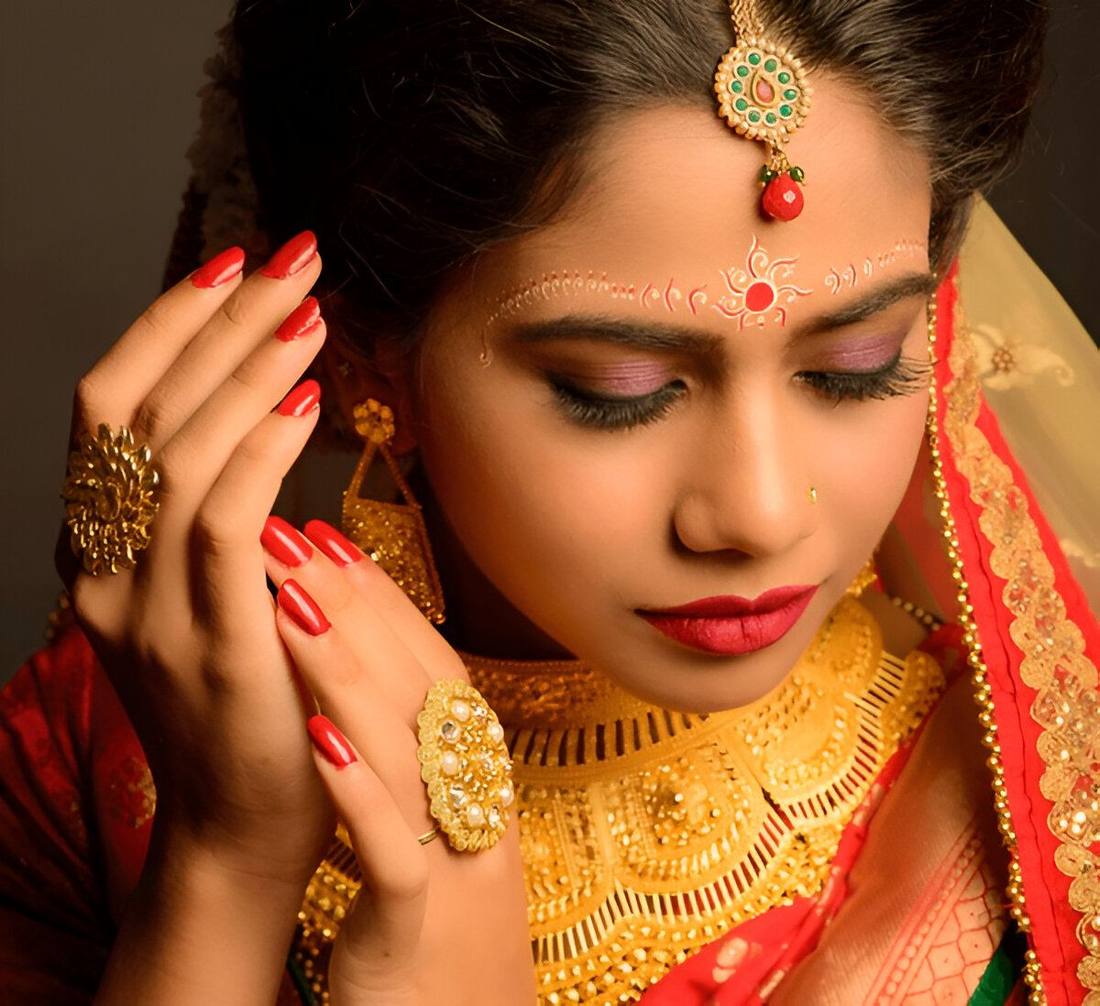
Three things that change for a natural look
1. Colour-correcting does more of the work than contour
Instead of relying on heavy contour to shape the face, more time goes into colour-correcting redness, pigmentation and under-eye tone underneath a lighter base — so the skin looks genuinely even rather than covered over.
2. Eye and lip work stays in your own tonal family
Rather than a bold, high-contrast bridal eye or lip, shades are chosen close to your natural pigmentation — deeper and more defined than everyday makeup, but recognisably you rather than a dramatic departure.
3. Setting and durability standards don't drop
A natural look still has to survive an eight-hour Bengali wedding day, tears, hugs and humidity. Skin prep and setting technique are just as thorough as for a full-glam look — a "lighter" finish that doesn't last isn't actually the brief.
Works well combined with tradition: a natural base pairs naturally with chandan facial art and aalta on hands and feet — the natural-look choice is specifically about the base and eye makeup, not about simplifying the rest of the traditional bridal look.
Frequently asked
What does a "no-makeup look" bride actually mean?
It doesn't mean no product is used — a full wedding-day base, eye work and lip colour are still applied. It means the techniques and shades are chosen so the result reads as your own skin, only more even and polished, rather than a visibly different, heavily contoured face.
Most "no-makeup look" brides still want full coverage of blemishes and long wear; they just don't want it to look obviously done.
Is natural bridal makeup cheaper than the standard look?
No. It's priced the same as the standard bridal rate, currently from ₹8,000, because it isn't a lighter or shorter service — it's a different technique that in some ways requires more precision, since there's less product to hide imperfect blending.
Will a natural look still photograph well and last all day?
Yes, when it's planned as a proper wedding-day base rather than everyday makeup. Skin prep, colour-correcting and setting are all still done thoroughly — the difference is in shade choice and how heavily contour and colour are applied, not in how durable the finish is.
Can I combine a natural look with traditional Bengali elements like chandan and aalta?
Yes, and this combination is common. Traditional chandan facial art and aalta on hands and feet sit naturally alongside a skin-forward base — the natural-look choice is about the base and eye makeup, not about skipping traditional elements.
Is a natural look suitable for all skin types and tones?
Generally yes, though skin with significant texture or pigmentation concerns may need more targeted colour-correcting underneath to still achieve an even, natural-looking result — which is exactly what the trial is for, so there are no surprises on the wedding morning.
Send a recent photo.
We'll plan around it.
A current, unfiltered photo of your skin helps far more than a reference image of someone else's face — send one over WhatsApp and I'll tell you honestly what's realistic.
Related: HD & Ultra HD makeup · Bridal makeup trial · Bridal makeup in Barasat